Author: Sagara Technology

  • What Does it Mean by Full-Stack Development?

    What Does it Mean by Full-Stack Development?

    What is Full Stack Development ?

    Full-stack development refers to the development of both front end and back end portions of an application. This web development process involves all three-layer- Presentation layer (front end part that deals with the user interface), Business Logic Layer (back end part that deals with data validation) and the Database Layer. It takes care of all the steps from the conception of an idea to the actual finished product.

    Having a specialist work on each of the different subsystems of the web development process proves quite complex and expensive. Companies are demanding full stack developers who are proficient in working across multiple stacks.

    Read more: What to Choose between Native or Hybrid Development

    What is a full-stack developer?

    A Full-Stack Web Developer is a web developer or engineer who works on both the front-end and back-end of a website or application — meaning they can tackle projects that involve databases, building user-facing websites, or even work with clients during the planning phase of projects. Being a Full-Stack Developer doesn’t mean that you have necessarily mastered everything required to work with the front-end or back-end, but it means that you are able to work on both sides and understand what is going on when building an application.

    In fact, “full-stack” refers to the collection of a series of technologies needed to complete a project. “Stack” refers to a collection of sub-modules. These software sub-modules or components are combine together to achieve the established function while without the need for other modules.

    Technology related to full-stack development:

    There are some essential technologies that you must learn in order to call yourself a full-stack developer. Here is a quick guide to what technologies you must learn.

    HTML and CSS

    To begin your career in web development you must have a fundamental knowledge of HTML and CSS. They are the basic building blocks of the web that enable you to add content and styles to your web pages. So start your journey of becoming a full-stack developer by gaining a sound understanding of these front-end concepts.

    JavaScript

    The fact that JavaScript can be used both in front-end and back-end development makes it very popular. It is one of the hottest technologies in the market where continuous innovations take place. With new tools and frameworks getting released every year, one needs a piece of sound knowledge in this area. Knowledge of JS frameworks like AngularJS and ReactJS would help one to write long codes with ease. A solid understanding of jQuery would be an added advantage.

    Backend programming languages

    After gaining a strong foothold in the front-end arena next comes backend languages like Ruby, Python, PHP, etc. which handle application logic, user authentication, and data operations. Start with a language that is easier to learn. Whatever language you choose, just make sure you are thorough with its nuances. You may learn NodeJS which is based on JavaScript that you would have already learned before reaching this point.

    Database & Web Storage

    In order to design and develop dynamic websites, one should surely know how database-driven websites store and access data. Learn the benefits of relational database management systems like SQL. Understand how to connect a backend language with a database. Gain knowledge about web storage so that you know how to store cookies, sessions and cached data in the browser.

    HTTP and REST

    You must gain insights into HTTP- that is the protocol required to facilitate communication between the client and server. You must also know how REST is important to the HTTP protocol and web applications. Knowledge of Chrome DevTools and SSL certificates would be advantageous.

    Read also about Fundamentals of Front End and Back End Development

    Additional skills set to adopt as full-stack developers are as follows

    • Application Architecture

    Developing complex applications would require a deep knowledge of how the code should be structured, how the data needs to be structured in the database, how to separate files, where to perform computational tasks and where to host large media files. So a full stack web developer surely needs a deep knowledge of web application architecture.

    • Version control system

    A full-stack web developer needs to be well versed with a version control system. An understanding of GIT will help you keep track of any changes that you make to the codebase.

    Acquiring expertise in so many technologies and becoming an expert in all the layers of web development may seem like a daunting task in the beginning. It’ll be hard work learning all of this, but it’s rewarding in the end and Full-Stack Development is fun!

  • What is Django and Why is it Used?

    What is Django and Why is it Used?

    Choosing a web development framework is a big deal. There are quite a few frameworks on the market, each designed to address different project needs. For many companies and independent projects, the Django framework is an easy choice — it’s one of the most popular web development tools. But why is that? What is Django used for? Let’s figure out what Django is and why so many developers around the world use it — and how you can do the same.

    What is the Django Framework?

    Django is an open-source python web framework used for rapid development, pragmatic, maintainable, clean design, and secure websites. A web application framework is a toolkit of all components needed for application development.

    The main goal of the framework is to allow developers to focus on components of the application that are new instead of spending time on already developed components. Django is fully featured than many other frameworks on the market. It takes care of a lot of hassles involved in web development; enables users to focus on developing components needed for their application.

    Top 5 Uses of Django

    1. Easy to Use

    Django uses Python programming language which is a popular language in 2015 and now most choosing language by programmers who are learning to code and applications of the framework is widely used as it is free and open-source, developed and maintained by a large community of developers. It means we can find answers to the problems easily using Google.

    2. It’s fast and simple

    One of Django’s main goals is to simplify work for developers. To do that, the framework uses:

    • The principles of rapid development, which means developers can do more than one iteration at a time without starting the whole schedule from scratch
    • DRY philosophy — Don’t Repeat Yourself — which means developers can reuse existing code and focus on the unique one.

    3. Excellent Documentation for real-world application

    Applications of Django have one of the best documentation for its framework to develop different kinds of real-world applications whereas many other frameworks used an alphabetical list of modules, attributes, and methods. This is very useful for quick reference for developers when we had confused between two methods or modules but not for freshers who are learning for the first time. It’s a difficult task for developers to maintain the documentation quality as it is one of the best open-source documentation for any framework.

    4. It’s secure

    Security is also a high priority for Django. It has one of the best out-of-the-box security systems out there, and it helps developers avoid common security issues, including

    • clickjacking,
    • cross-site scripting
    • SQL injection.

    Django promptly releases new security patches. It’s usually the first one to respond to vulnerabilities and alert other frameworks.

    5. It suits any web application project

    With Django, you can tackle projects of any size and capacity, whether it’s a simple website or a high-load web application. Why use Django for your project? Because:

    • It’s fully loaded with extras and scalable, so you can make applications that handle heavy traffic and large volumes of information
    • It is cross-platform, meaning that your project can be based on Mac, Linux or PC
    • It works with most major databases and allows using a database that is more suitable in a particular project, or even multiple databases at the same time

    Finally, it’s an overview of Django, how we need to use it, and its use in real-world application development. I hope you will have a good understanding of the Django framework once you have read these uses of the Django article. So choose Django if you need to complete your web application or website within a short time with full security and offers fast, reliable and scalable services based on traffic. Many good websites are developed using the Django framework like Instagram, BitBucket, Mozilla, and etc.

    Read also more Sagara’s article here.

  • What is Data Science? 6 Steps to Become a Data Science

    What is Data Science? 6 Steps to Become a Data Science

    Becoming a Data Science is a relatively new career trajectory that merges statistics, business logic, and programming knowledge. Given the exponential amount of data being churned out via our smartphones, desktops, and the vast array of IoT devices throughout the world, governments and private enterprises are interested in gleaning insight from their extensive data collection processes.

    Regardless of your previous experience or skills, there exists a path for you to pursue a career in data science. We here to help you know what skills you need to develop, and where you can learn them.

    This guide provides a basic overview of some of the opportunities in this emerging field and lists the skills to become a data scientist. Let’s get started!

    What is a Data Scientist?

    Data Scientists must possess statistical knowledge and computer skills that are needed for solving complex problems. Using descriptive, predictive, inferential, and causal models, they can explore and anticipate problems then work to model a solution based on a multitude of factors.

    Data scientists are a part mathematician and part computer scientist. Their skill set encompasses both the business and information technology sectors, which is why they are highly sought after.

    Data science is a deep knowledge discovery through data exploration and inference. This discipline focuses on using mathematical and algorithmic techniques to solve some of the most analytically complex business problems. In doing so, they leverage the troves of raw data to figure out the hidden insight that lies beneath the surface. The core of the field centers around evidence-based analytical accuracy and building strong decision capabilities. However, data scientists must also verbally and visually communicate their findings to stakeholders who may or may not understand the statistical jargon. Thus, data scientists must be excellent communicators.

    What is the necessary background?

    The first waves of data scientists were primarily from development personnel, computer scientists, and engineers. They were the ones who created machine learning models that optimized the process and minimized the cost function. They would analyze unstructured data, create specific programs for each problem, and, due to limitations of the computational processing, do manual map / reduction.

    The good news is people from different backgrounds have the opportunity to join this field and one of the main reasons is the intense use of Python which is a high- level language acting as an API for much more performative low- level languages. In other words, you don’t have to waste energy worrying about complicated syntax, because writing in Pythonis like writing in English. You just need to study for a few weeks to master the basics.

    Six steps to become a Data Scientist

    Step 1: Preparation

    Future data scientists can begin preparations before they even step foot on a university campus or launch themselves into an online degree program. Becoming proficient with the most widely used programming languages in data science such as Python, Java, and R — and refreshing their knowledge in applied math and statistics — will help aspiring data scientists get a head start. In fact, entering college with an already established skillset frequently improves a student’s learning rate. But, also, early exposure to data science knowledge requirements is helpful for determining whether a data science career is the right fit.

    Step 2: Complete undergraduate studies

    The most sought-after majors for data science are statistics, computer science, information technologies, mathematics, or data science (if available). Minoring in one of the aforementioned fields is also recommended. Continue to learn programming languages, database architecture, and add SQL/MySQL to the “data science to-do list.” Now is the time to start building professional networks by looking for connections within college communities, look for internship opportunities, and ask professors and advisors for guidance.

    Step 3: Obtain an entry-level job

    Companies are often eager to fill entry-level data science jobs. Search for positions such as Junior Data Analyst or Junior Data Scientist. System-specific training or certifications in data-related fields (e.g., business intelligence applications, relational database management systems, data visualization software, etc.) might help when looking for entry-level data science jobs.

    Step 4: Earn a Master’s Degree or a Ph.D.

    Data science is a field where career opportunities tend to be higher for those with advanced degrees. The in-demand graduate degrees for data science include the exact same specifications for an undergraduate degree: data science (if available), computer science, information technology, math, and statistics. However, many companies also accept STEM degrees such as biotechnology, engineering, and physics (among others). Also keep in mind that data scientists need to understand how to use enterprise-grade data management programs and how distributed storage and computation operate (e.g., Hadoop, MapReduce, and Spark) in relation to model building and predictive analytics.

    Step 5: Get promoted

    Additional education and experience are key factors that lead to being promoted or becoming a data scientist in high demand. Businesses value results. Coupling strong technical skills with project management and leadership experience will generally chart a course towards more significant opportunities and higher compensation.

    Step 6: Never Stop Learning

    Staying relevant is crucial to the ever-evolving field of data science. In this age of constant technological innovation, continuing education is a hedge against shifts in the career market. This is also the case for data science since the field isn’t as established as other statistically and technologically focused careers. A career-oriented data scientist is always learning and evolving with the industry. Continue to network and look for educational and professional development opportunities through boot camps and conferences.

    In general, the data science outlook continues to be on the upward trajectory as the influx of data isn’t likely to cease anytime soon and enterprises will need someone with the skills to parse through data tangle and help increase its value.

    (SA)

  • How to Create Design System for User Interface?

    How to Create Design System for User Interface?

    A design system is a collection of elements that can be combined and reused to build products. A design system is about communication. A well-crafted design system establishes a common shared language among team members, and this language allows the team to collaborate more effectively. Thus, the ultimate goal in creating a design system is to create both a single source of truth that can be referred to during product design and an effective shared language that all team members can use when working on a product.

    A UI design system is a set of standards for design and code along with components that complement each other and producing the conceptualized result. A UI system helps your users navigate intuitively, making them familiar with your design language.

    Read more : The Creative Process of User Interface Design

    Why do we need a UI System?

    To design consistent UI across every part of your design can be daunting. A UI system helps your users navigate intuitively and makes it uniform across your product, making them familiar with your design language.They help teams by giving them a more structured and guided way to build UI for their products.

    Creating a UI Design System

    The best way to start is by building an inventory of all the different patterns, colours, text styles and assets which you will use in your design. It should be a clear inventory which shows all the components and features needed to build a product (Website or Application).

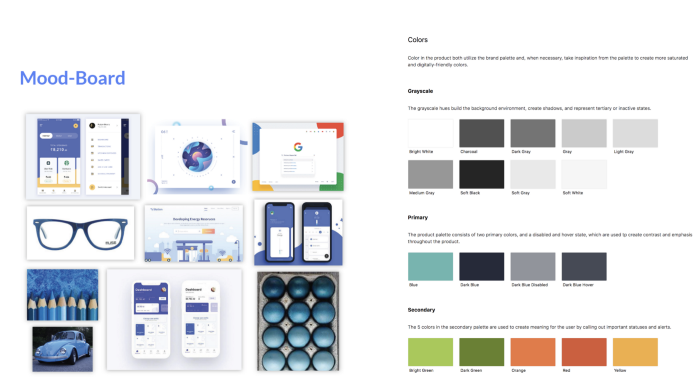
    Moodboards & Colour Palette

    Let’s start by creating a mood board and colour palette, this way you set the theme of your design and have quite a good picture on what your design would look like. Your mood board could be pictures of trending UI, inspirational products or images which you are inspired from. This mood board also helps you select your colour palette, remember your colour selection is also based on your research. List down your Primary, Secondary & Tertiary colours and Greyscale. Greyscales are used for various elements in your UI Design system. Most UIs will need at least the following grey colours:

    • A very light grey for backgrounds
    • A slightly darker grey for borders, lines, strokes or dividers.
    • A medium grey for subheadings and supporting body copy.
    • A dark grey for main headings, body copy and backgrounds Ideally, you’d want to keep tints and tones of your primary colours they may come in handy.

    As a final touch, we may want to add tint or tone variations for each of your colours. These can be useful when it comes to designing components for adding light backgrounds or dark strokes.

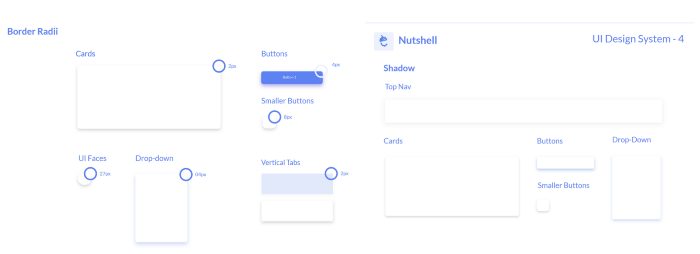
    Border Radius and shadows

    Following up colour, let’s start setting up the border-radius and shadows for your UI. Border radius sets the tone for your UI Cards, Tables and changes the overall look and feel of your UI.

    Shadows are mostly used to apply depth and perspective into our design. Lately, shadows have been trending and they are used to distinguish between multiple elements in your UI. These four shadows should be enough to style every component in our system:

    • A subtle shadow to raise interactive components and add affordance.
    • A more pronounced shadow for a hover effect on components.
    • A strong shadow to give perspective to dropdowns/popovers and other similar components.
    • A distant shadow for modal components.

    Read more : Why Digital Product Stage Development Matter?

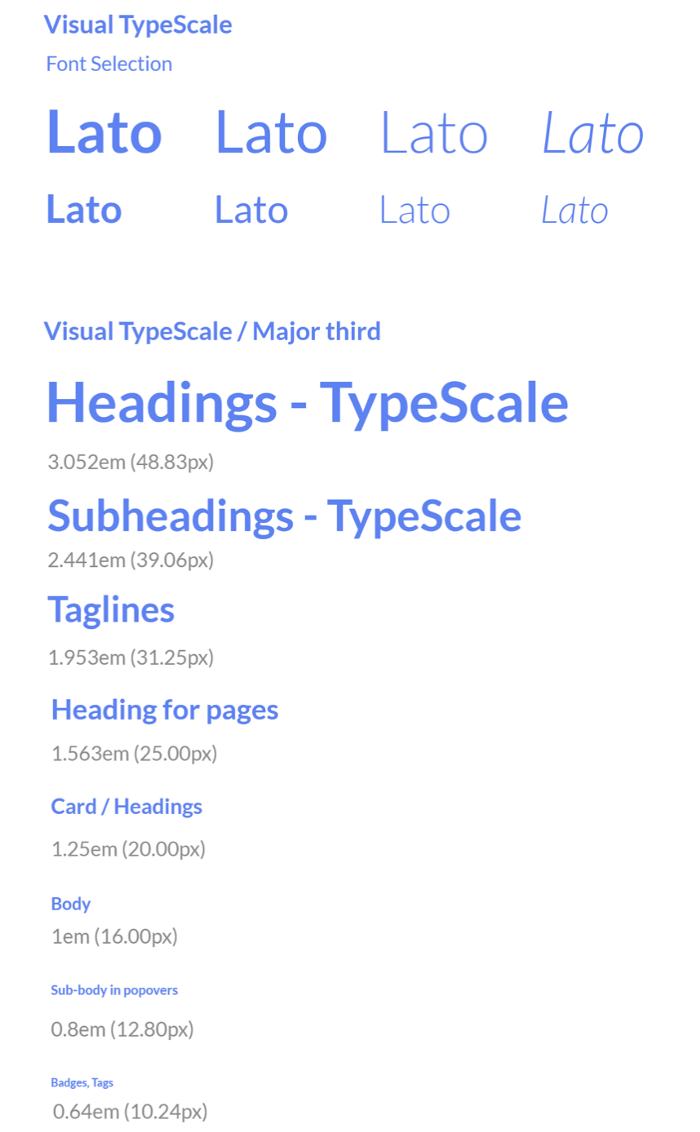
    Type scale

    There’s no UI without Type hierarchy. Type follows a rhythm. You need fonts to complement each other as well as a good scale for different tags. All you need to do is select a type scale and it lists down different sizes which could be used. For websites, I would recommend the Major Third Type Scale.Here’s what all type of font-scales you may need.

    • Default (1em) for standard text that will appear in many places throughout our marketing site, UI etc. 16px is the default browser font size so let’s run with that.
    • A slightly larger size for large body copy in a blog for example.
    • A couple of larger sizes for headings and subheadings.
    • Very large size for section titles.
    • A ridiculously large size maybe for prices on a pricing page for example.
    • We will also need some smaller sizes for smaller body copy, input hints and other secondary text.

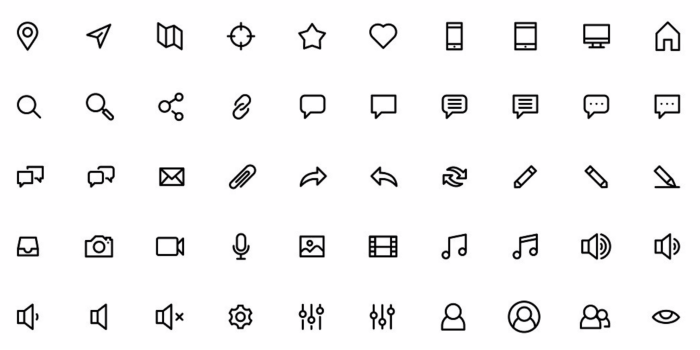
    Icons

    Make your Icons uniform. For starters, you could just use Icon set packs which are free to use so you don’t spend much time on making icons yourself, but always make sure it’s uniform.

    Buttons, Sliders & Progress Bars

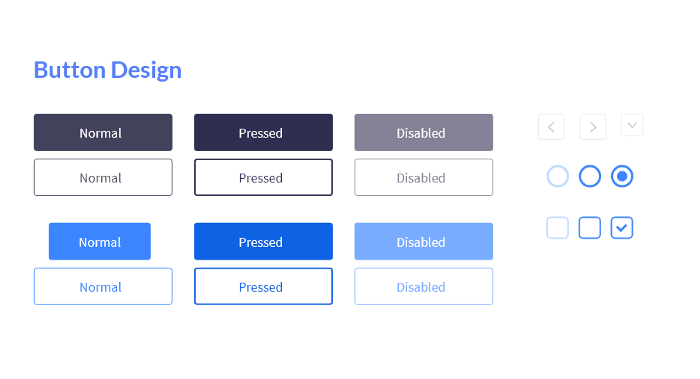
    Buttons are going to be really vital elements of your UI Design. Buttons allow users to take actions, and make choices, with a single tap. Buttons communicate actions and hence should be designed according to their work functions. They should be easily findable and identifiable while clearly indicating the action they allow a user to complete. There are various types of buttons. Showing the status of buttons is also an important part of your UI.

    • Buttons
    • Radio Buttons
    • Checkboxes
    • Navigation Buttons

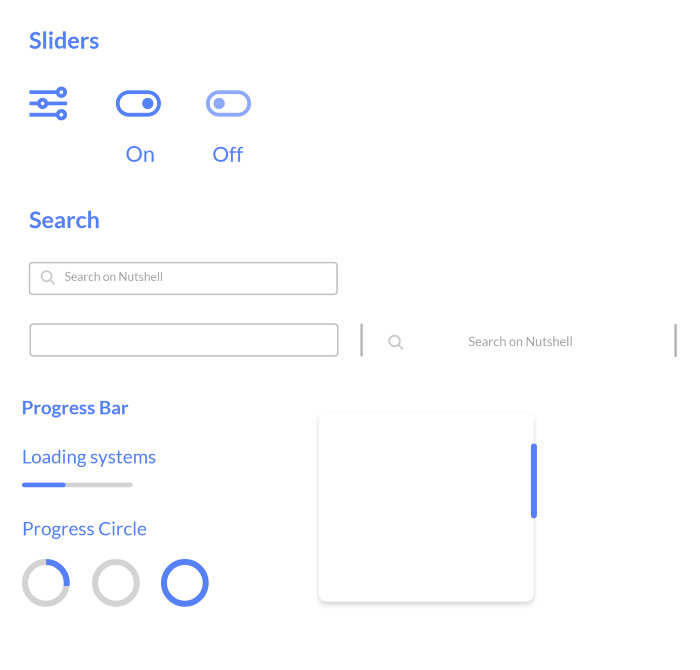
    Sliders, Progress Circles help you define these small elements to make your UI look even more uniform. Breaking them down will also help you design other elements better.

    Dropdowns, Tags and Popups (Complex elements)

    Now that we’ve set a basic guideline, you could all these other elements to build dropdowns, Tags and Popups

    Sagara Technology can help you develop beautiful and functional interfaces for desktop and mobile applications. At Sagara Technology we develop attractive, engaging, usable interface design that focuses on solving usability problems and producing outstanding results.

    Read also Sagara’s article here.

  • An Introduction to Big Data Concepts

    An Introduction to Big Data Concepts

    Big data is a blanket term for the non-traditional strategies and technologies needed to gather, organize, process, and gather insights from large datasets. While the problem of working with data that exceeds the computing power or storage of a single computer is not new, the pervasiveness, scale, and value of this type of computing have greatly expanded in recent years.

    In this article, we will talk about big data on a fundamental level and define common concepts. We will also take a high-level look at some of the processes and technologies currently being use in this space.

    What Is Big Data?

    An exact definition of big data is difficult to nail down because projects, vendors, practitioners, and business professionals use it quite differently. With that in mind, generally speaking, that is:

    • large datasets
    • the category of computing strategies and technologies that are used to handle large datasets

    In this context, a large dataset means a dataset too large to reasonably process or store with traditional tooling or on a single computer. This means that the common scale of big datasets is constantly shifting and may vary significantly from organization to organization.

    Why Are Big Data Systems Different?

    The basic requirements for working with big data are the same as the requirements for working with datasets of any size. However, the massive scale, the speed of ingesting and processing, and the characteristics of the data that must be dealt with at each stage of the process present significant new challenges when designing solutions. The goal of most that systems is to surface insights and connections from large volumes of heterogeneous that would not be possible using conventional methods.

    In 2001, Gartner’s Doug Laney first presented what became known as the “three Vs of big data” to describe some of the characteristics that make different from other data processing:

    Volume: Organizations collect data from a variety of sources, including business transactions, smart (IoT) devices, industrial equipment, videos, social media and more. In the past, storing it would have been a problem — but cheaper storage on platforms like data lakes and Hadoop have eased the burden.

    Velocity: With the growth in the Internet of Things, data streams into businesses at an unprecedent speed and must be handle in a timely manner. RFID tags, sensors, and smart meters are driving the need to deal with these torrents of data in near-real-time.

    Variety: Data comes in all types of formats — from structured, numeric, in traditional databases to unstructured text documents, emails, videos, audios, stock ticker, and financial transactions.

    Other Characteristics

    Various individuals and organizations have suggested expanding the original three Vs, though these proposals have tended to describe challenges rather than qualities. Some common additions are:

    Veracity: The variety of sources and the complexity of the processing can lead to challenges in evaluating the quality of the database (and consequently, the quality of the resulting analysis)

    Variability: Variation in the data leads to a wide variation in quality. Additional resources may be need to identify, process or filter low-quality to make it more useful.

    Value: The ultimate challenge of big data is delivering value. Sometimes, the systems and processes in place are complex enough that using the database and extracting actual value can become difficult.

    Why It Is Important?

    The importance of that doesn’t revolve around how much data you have, but what you do with it. You can take data from any source and analyze it to find answers that enable 1) cost reductions, 2) time reductions, 3) new product development and optimized offerings, and 4) smart decision making. When you combine with high-powered analytics, you can accomplish business-related tasks such as:

    • Determining root causes of failures, issues, and defects in near-real-time.
    • Generating coupons at the point of sale based on the customer’s buying habits.
    • Recalculating entire risk portfolios in minutes.
    • Detecting fraudulent behavior before it affects your organization.

    Big data is a broad, rapidly evolving topic. While it is not well-suited for all types of computing, many organizations are turning to that for certain types of workloads and using it to supplement their existing analysis and business tools. This is a systems are uniquely suited for surfacing difficult-to-detect patterns and providing insight into behaviors that are impossible to find through conventional means. By correctly implementing systems that deal, organizations can gain incredible value from data that is already available.

    Read also more Sagara’s Article here.

  • The Basic Process of Back End Development

    The Basic Process of Back End Development

    Back End Development
    Source: Freepik

    After knowing the Front End Development Process now this article will discuss the Back End Development process.

    The backend is the part that you can’t “see”. It is the internal working of the application or website. This includes stuff like the server, the database, etc.

    To help you become a pro in all things back-end development, we’ve gathered up a series of articles that cover some key things to know — in a way non-developers can understand. Let’s read this article!

    The Back-End

    The back-end — also known as CMS (content management system) or back office — is the part of the app that remains hidden to users (but not to the admin or developers).

    Its job is to :

    1) access the information that users require through the app,

    2) combine and transform such information, and

    3) return the information in its new shape to the requester.

    To put it another way, the back-end makes its entrance into the app in order to give life to the front-end.

    Work Processes of the Back-End Development

    As mentioned above, there are three duties of a back-end platform. Let’s examine each in greater detail.

    1. Access the Information Users Require through the App

    Regardless of the nature of the product, users continuously ask for data when using an app.

    This is true whether it’s a “get-nice-info” app that shows public transit maps and timetables or a kids’ game that allows users to make their own Barbie dolls.

    2. Combine the Information Gathered and Transform It

    The data or information that is required for an app to work can come from lots of different places, which are known as databases.

    At this point, the duty of the back-end is to find the specific information the user needs within the various databases — which are enormous, by the way — and then combine it in a way that provides useful results.

    Imagine that you have downloaded a how-to-get-there app and now want to know how to arrive quickly to your new job. In this example, the app will need to access the information from your city bus databases, but also from those of any other modes of public transit, taxi companies, and Google Maps.

    Sounds tough, right? It can be challenging, but a well-built back-end is able to surgically find the information demanded. The key is that its structure is designed based on the particular questions it will have to answer throughout its life.

    Which begs the question: what happens if the questions that the back-end has to answer change over time?

    Happily, there’s no need to worry. The skeleton of the back-end is always optimizable, and developers will always be able to introduce new job orders or questions to answer within its code.

    3. Give the Information Back to the User

    Finally, once the back-end has gathered and combined all of the information requested, the data must be sent to the user.

    But how many users know how to read the information in pure code that the back-end produces? Probably only a small handful.

    Because of this, needs “translators” to be able to translate the pure code into a human language. Here come the famous APIs and the front-end, anew.

    In this overview, I hope you have gained some insight into what it means to be a backend developer and Work Processes of the Back-End Development.

    If you are considering pursuing a career in development, you need to have some patience to learn to get there. Remember that an expert at anything was once a beginner too.

  • What Languages are Used for Back-End Development?

    What Languages are Used for Back-End Development?

    Back-end code is the one that communicates with the front-end sending and receiving messages that have to be interprete and display on the web page. Further to this, there are 2 kinds of websites- static and dynamic. A static web page is the one who’s contents do not change much and a dynamic web application is one whose contents change according to the data present in its database and can be customize. Every website needs a database that manages and stores all the information. The many databases in the market are Oracle SQL, MySQL, PostgresSQL and SQLServer. Some of the back end programming languages used to create dynamic websites are C, C++, Java, Ruby, PHP, .Net and Python.

    List of Back-end Programming Languages

    Here let us go through some of these languages and get a basic idea on how to use them:

    1. Java for Back-end

    Java is a general-purpose, object-oriented and concurrent programming language developed by Sun Microsystems in 1995. It uses an engine called JVM (Java Virtual Machine) which provides a runtime environment to run the Java Code and its applications. It translates Java byte code into a language that can be interprete by machines. JVM forms a part of JRE (Java Runtime Environment).

    Java has certain key features as follows:

    • Object-oriented– This means the code is structure and model as a set of objects which can be manipulate, control, and easily extend.
    • Basic– Java language is very basic and simple to master once you have understood the concept of OOP (Object Oriented Programming)
    • Platform independent– Java does not depend on any specific platform because, during compilation, it is compile to an independent bytecode format which can be distribute and translate by JVM on any platform.
    • Robust– Java has good Memory management and Exception handling which makes it minimize error-prone code.
    • Multi-Threading– Java can run multiple tasks concurrently due to this feature which helps save a lot of memory.

    Example

    Let us get to know how to write a basic program in Java:

    public class JavaFirstProgram {
    public static void main(String []args) {
    System.out.println(“Hello World”); // outputs Hello World to console output
    System.out.println(“First program in Java”);
    }
    }

    2. Ruby

    Ruby is a programming language coded by Yukihiro Matsumoto during the mid-1990s. It is an open-source, object-oriented, dynamic and reflective language. Like Java, it is platform-independent and hence can run on Windows, Mac, and all Unix versions. Ruby follows a principle called POLA (Principle Of Least Astonishment) which means that the language reduces the confusion for experienced users.

    Some of the features of Ruby are:

    • Object-oriented– This means everything in Ruby is express in the form of objects. Every object will have a class and each class will be having a superclass. All the rules written for objects applies for entire Ruby.
    • Flexibility– In Ruby we can add, remove and customize parts easily. Existing parts can be modify and there are no such restrictions as such.
    • Dynamic typing– Programs in Ruby are not compile as such. A variable can hold all types of objects. Ruby looks up a method name when it is call, regardless of the object type.
    • Mixin– One of the unique features of Ruby is that it has a single inheritance only. It mainly operates on modules that don’t have many instances. Alternatively, a module can be unite with class.
    • Hashing– It is one of the collection types of key-value pairs separate by commas.
    • Open– This means Ruby classes and methods can be end with a question and exclamation marks.
    • Persistence– In case of missing method, Ruby calls the same with its name with which it could not locate its arguments.

    Example

    For the following programs, open any editor and save the file in .rb format.

    • We can output any sentence with “puts” keyword as follows:

    puts “Hello example in Ruby”

    • Simple mathematics can be perform in Ruby as below:

    # Arithmetic operator examples for: +, -, /, *
    puts 4 * 5
    # Example for finding the exponent of 4 to the power of 2
    puts 4**2
    # To find modulus and retrieves the remainder of 4
    puts 13 % 4
    # Example for the order of the given operations
    puts 3 + 5 * 8
    # Performing operation on integer and floating-point numbers
    puts 10 / 3.0

    • The variable types need not be mention here since Ruby identifies it automatically:

    distance = 0.4
    #We shall use integer and float type both
    time = 8.65 / 3600
    speed = distance / time
    puts “The average speed of the car is #{speed} km/h”

    3. Python

    Python is an open-source, object-orient, and interactive programming language that was name after a television show call “Monty Python’s Flying Circus” by Guido van Rossum in 1991. It is an interpreted language which means there is no compilation require to run it.

    Some of its key features are:

    • Dynamic typing– The variable data type need not be declare explicitly as they are allot in run-time.
    • Extensive and integrable– Other languages like C and C++ can be unified with Python. It is call to be extensible.
    • High-Level– This enables its users to focus on the problem-solution than worrying about the system architecture or memory management.
    • Interpreted– Python code execution takes place line by line and since there is no need for compilation, it is easy to debug.
    • Extensive Standard Library– There are many built-in modules and functions in its library hence reducing the coding effort. Also, a lot of libraries are present such as regular expressions, web browsers, testing, etc.
    • Expressive– Python is easier to understand and read hence helps to focus on the solutions than on syntax.
    • GUI Support– Graphical User Interface can be develop using Python.

    Examples :

    Let us go through some of the basic coding examples in Python.

    • The print command is use for printing the output as follows :

    print(“Hello World Example for Python”)

    • Defining variables can be written as below :

    number = 25 # Assigning an integer
    decimal = 33.3 # Assigning a floating number
    string = “Any Name” # A string
    common1 = common2 = 10 # Common Assigning of values
    print number, “\n”
    print decimal, “\n”
    print string, “\n”
    print common1, “\n”
    print common2, “\n”

    • A simple for loop is as follows:

    animals = [“cats”, “dogs”, “cows”, “monkeys”] for i in animals:
    print(i)
    if i == “cows”:
    break

    Read also about The Beginner’s Guide to Python Back-End Development

    4. PHP for Back-end

    “PHP: Hypertext Preprocessor” which previously stood for “Personal Home Page” is another open-source scripting language used in the server-side. It is very popular being use in various big giants like WordPress and Facebook. PHP language can only be interprete by the server having PHP install. Its file ends with an extension “.php”. Compared to other languages PHP is consider a stable language.

    PHP has some unique features as follows:

    • It can be integrate with other databases like Oracle, MySQL, Sybase, PostgreSQL, Microsoft SQL Server, and Informix.
    • It has extensive libraries for using various modules and for data representation.
    • It is again an interpreted language and also platform-independent
    • In PHP all the keywords, methods, classes and user-defined functions are not case-sensitive and are only case-sensitive when a variable is declare.
    • PHP generates dynamic content.
    • It has a built-in error reporting system thus helps to generate a warning/error notice.
    • It creates a summary of the latest accesses for the user by providing real-time access logging.
    • There is no need to declare a data type in PHP as the data type will be retrieve during execution based on the value of the variable. Hence called a loosely typed language.

    Examples

    • Below is the example for declaring and displaying variables in PHP:

    <?php
    $x = “This is a sentence!”; //Assigning a sentence
    echo $x;
    echo “<br/>”;
    $str=”String Example”;
    $x=30;
    $y=22.2;
    echo “String value is: $str <br/>”;
    echo “Integer value is: $x <br/>”;
    echo “Float value is: $y <br/>”;
    ?>

    • A basic for loop example can be written as follows:

    <?php
    for($i=10;$i>=2;$i — ){
    echo “$i <br/>”;
    }
    ?>

    In this blog, we hope you have got a better picture of some of the most popular and widely used back-end programming languages. Based on the explanation shown for all, it is up to you to decide the language you choose according to your business requirements.

    This does not mean that these are the only 4 languages out there. Day by day, lot of new scripting language are emerging which can also be include in your project. Thus, a back-end developer should identify the goals first and integration requirements before choosing a programming language.

  • What are The Benefits of Kotlin?

    What are The Benefits of Kotlin?

    Kotlin, a programming language, has gained an astounding amount of interest among developers in the past four years — especially following Google’s #IO17 announcement supporting it as an official language for Android apps. So what makes this language so special, what are the benefits of Kotlin, and how can it help your business?

    What is Kotlin?

    Kotlin is a programming language for the Java Virtual Machine (JVM) and can, therefore, be used anywhere Java is used today (which is virtually anywhere). This includes server, client, web, and Android development. It’s developed by JetBrains who are currently working to bring Kotlin to embedded systems and iOS as well, potentially making it a one-stop language for all application areas.

    What makes Kotlin so popular among developers is its clean language design and powerful features. Its goal is explicitly not to introduce new concepts, but to bring together programming language features that have proved to be beneficial for large-scale projects.

    Who’s using Kotlin?

    Although Kotlin can be used anywhere Java is used (and soon in more places), it is currently predominantly used for Android app development, spurred on by Google’s official support. Companies using it to stay competitive include Google, Trello/Atlassian, Pinterest, Kickstarter, and Uber to name just a few.

    The Benefit of Kotlin

    1. Kotlin allows writing less code

    Less code is important but there is readability that also should be considered and desirably improved. With Kotlin, you receive them both. JetBrains did their best to make the language as concise as possible, and they managed to do it.

    Less code, when done right, results in fewer bugs. When you let the framework take care of certain mundane aspects of coding, you can focus on more important things. It is all about high readability, simplicity, and the facilitation of the app development process.

    2. It solves developer challenges

    Kotlin came from the industry, not academia. JetBrains needed a simpler tool than Java to work with its main product, called IntelliJ IDEA, totally written in it.

    They investigated the alternatives, stayed unsatisfied, and decided to invent their own language. The goal was to get an effective tool that could be used together with Java and work everywhere where Java can.

    So, Kotlin solves challenges faced by programmers. For instance, the type system helps you avoid null pointer exceptions. Research academic languages tend to not have null at all, but this is of no use to software engineers working with large codebases and APIs which do.

    3. Adopting Kotlin is easy

    If you want to facilitate the product maintenance or streamline custom Android app development, you can assign two or three engineers to move the project, starting from a small part of the codebase.

    4. Kotlin is fully compatible with Java

    Another advantage is that the Kotlin programming language is fully compatible with Java. The developers have access to all Java frameworks and libraries while writing more clear and concise code.

    So, Android engineers can use both languages when building a mobile product as well as migrate their applications from Java to Kotlin.

    Even if you have a large Java-based project with millions of code lines, you can easily convert it to one file at a time and you’ll see everything still successfully compiling. Here in BLAKIT, we write our code in Kotlin and use Java only for maintaining old projects.

    5. It imposes no runtime overhead

    The standard library is small and tight: it consists mostly of focused extensions to the Java standard library. Heavy use of compile-time inlining means functional constructs like pipelines of map/filter/reduce compile similarly to an imperative version of the same code.

    6. Has a strong community

    JetBrains is constantly improving its language. It’s committed to the project, has a large and highly competent team working on it, has a stable business model, and is even converting parts of its own flagship product to use it.

    7. Kotlin suits for the multi-platform development

    Android development isn’t the only thing you can use Kotlin for. The language provides JavaScript support and interoperability, enabling developers to move their frontends to Kotlin or create them in it from the very project beginning.

    What’s more, the founders added Gradle support so that you can write Gradle files in it. They are actively developing Kotlin/Native, which allows building iOS applications. This way, you can even write native apps in this language, too.

    8. Kotlin development offers more safety

    The developers integrated into the semantics the principles that prevent a variety of common mistakes usually happening during the program execution. Another reason for Kotlin’s higher-level safety (compared to Java) lies in its benefits.

    The business benefits of switching to Kotlin

    Being more fault-proof, the app will become easier and cheaper to maintain. It also facilitates faster development because it is much more concise — rough estimates show that it can cut as much as 40% lines of code compared to Java.

    Fewer lines of code = less time spent on coding = less money spent on development. Oh, and there’s an automatic Kotlin-to-Java converter, too, which you can find here.

    It is also becoming more and more universal, so you will be able to transfer your app from one platform to another if need be. Lastly, the framework is new, efficient, and exciting, which attracts good developers.

    It enables the implementation of the same tasks with less time and effort. When the code is more simple and easy to understand, errors are more difficult to make and much easier to find, so the chances for them significantly decrease.

  • 5 Important Reasons Why You Should Use Python

    5 Important Reasons Why You Should Use Python

    Python has an expansive library of open-source data analysis tools, web frameworks, and testing instruments make its ecosystem one of the largest out of any programming community. Python is a powerful multi-purpose programming language created by Guido van Rossum. It has simple easy-to-use syntax, making it the perfect language for someone trying to learn computer programming for the first time. The language is also widely taught in universities and used for working with beginner-friendly devices such as the Raspberry Pi.

    The IEEE ranked Python as the #1 programming language in 2019, which continued its hot streak after ranking it #1 in 2018, #1 in 2017, and #3 top programming language in 2016. RedMonk’s June 2019 ranking had Python at #3, which held consistent from previous years’ rankings in 2018 and 2017.

    Some of the top companies use Python in their technology stacks:

    Instagram

    A social media platform that relies on Python to allow its 4 mil daily active users to photograph, edit, store, and share their creations in a personal digital album.

    Spotify

    A major market player and a music streaming app that incorporates data analytics to manage its Radio and Discover features.

    Python suits a variety of web projects, from simple to complex. It is widely used in different spheres such as travel, healthcare, transportation, finance, and many others for web development and software testing, scripting, and generation.

    5 Reasons Why You Should Use Python

    Readable and Maintainable Code

    While writing a software application, you must focus on the quality of its source code to simplify maintenance and updates. The syntax rules of Python allow you to express concepts without writing additional code. At the same time, unlike other programming languages, emphasizes code readability and allows you to use English keywords instead of punctuation. Hence, you can use it to build custom applications without writing additional code. The readable and clean code base will help you to maintain and update the software without putting in extra time and effort.

    Multiple Programming Paradigms

    Like other modern programming languages, Python also supports several programming paradigms. It supports object-oriented and structured programming fully. Also, its language features support various concepts in functional and aspect-oriented programming. At the same time, it also features a dynamic type system and automatic memory management. The programming paradigms and language features help you to use Python for developing large and complex software applications.

    Compatible with Major Platforms and Systems

    At present, Python supports many operating systems. It allows you to run the same code on multiple platforms without recompilation. Hence, you are not required to recompile the code after making any alteration. You can run the modified application code without recompiling and check the impact of changes made to the code immediately. The feature makes it easier for you to make changes to the code without increasing development time.

    Adopt Test Driven Development

    You can use Python to create a prototype of the software application rapidly. You can even build the software application directly from the prototype simply by refactoring the code. Python even makes it easier for you to perform coding and testing simultaneously by adopting a test-driven development (TDD) approach. You can easily write the required tests before writing the code and use the tests to assess the application code continuously. The tests can also be used for checking if the application meets predefined requirements based on its source code.

    Simplify Complex Software Development

    Python is a general-purpose programming language. Hence, you can use the programming language for developing both desktop and web applications. Also, you can use Python for developing complex scientific and numeric applications. You can take advantage of the data analysis features to create custom big data solutions without putting in extra time and effort. At the same time, the data visualization libraries and APIs help you to visualize and present data in a more appealing and effective way. Many developers even use Python to accomplish artificial intelligence (AI) and natural language processing tasks.

    However, Python, like other programming languages, has its own shortcomings. It lacks some of the built-in features provided by other modern programming languages. Hence, you have to use Python libraries, modules, and frameworks to accelerate custom software development. Also, several studies have shown that Python is slower than several widely used programming languages including Java and C++.

  • Top 5 Advantages of Using Laravel

    Top 5 Advantages of Using Laravel

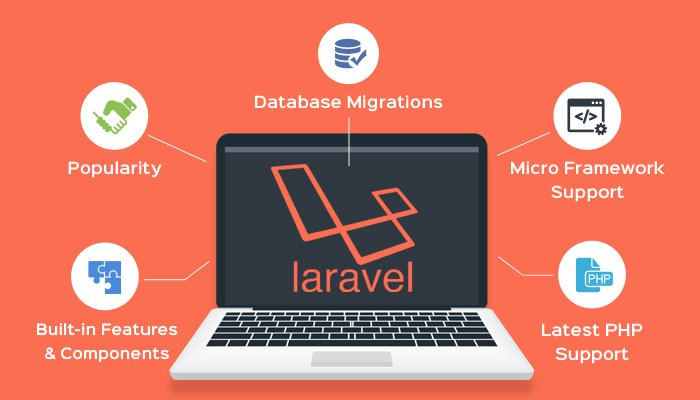
    Laravel framework is very popular for custom software development. It is the Most Starred PHP Framework on Github. More than 56.000 developers from all over the world greatly appreciate the robust features of this platform. Why is Laravel so popular? It gives the right tools to help build websites and web apps faster, more stable, and very easy to maintain.

    Laravel is one of the most popular PHP web frameworks following the MVC (Model-View-Controller) pattern. Created by Taylor Otwell, the framework is free and open-source, hence intended to help you come out with high-quality products. The codes will be reduced, but it will also be industry standards. So you can save hundreds of hours on development time. The first release was in 2011, and the current version came out with Laravel 5.4.

    Laravel- PHP framework offers a painless development cycle that simplifies the common task in a significant way which is used in most web projects. Let’s take a closer look at Top 5 advantages of using the Laravel PHP Framework.

    Top 5 advantages of using the Laravel PHP Framework.

    Authentication and Authorization Systems

    Each owner of the web application needs to ensure that users are who they claim to be and thus prevent unauthorized users from gaining access to secured/paid resources.

    Laravel benefit #1: Laravel makes implementing authentication very simple. Almost everything is configured out-of-the-box. Laravel also provides a simple way to organize authorization logic and control access to resources.

    Integration with Mail Services

    Mail service can be used to send notifications to users’ emails after various events. It’s hard to imagine a modern web application, for example, lacking even a simple email notification to a new user about their successful registration on the website.

    Laravel benefit #2. Laravel provides a clean, simple API over the popular SwiftMailer library. This also provides drivers for SMTP, Mailgun, Mandrill, SparkPost, Amazon SES, PHP’s “mail” function, and “Sendmail”, allowing an application to quickly get started sending mail through a local or cloud-based service. In addition, to supporting sending an email, this framework provides support for sending notifications across a variety of delivery channels, including SMS (via Nexmo) and Slack.

    Integration with Tools for Making Web Applications Faster

    It is important not just to create an application but also to create a fast application, which will result in accelerating revenue. Integration with the so-called caching backend is often one of the main steps taken to improve web application performance.

    Laravel benefit #3. Laravel supports popular cache backends like Memcached and Redis out-of-the-box. By default, Laravel is configured to use the file cache driver, which stores cached objects in the file system. For larger applications, it is better to use an in-memory cache such as Memcached or APC. However, with this framework it is even possible to configure multiple cache configurations.

    Fixing the Most Common Technical Vulnerabilities

    Security vulnerabilities go hand-in-hand with the development of any web application. American non-profit organization, The OWASP Foundation, describes the most critical web application security vulnerabilities: SQL injection, cross-site request forgery, cross-site scripting, etc. The developer must not forget and be able to fix all of them before delivery.

    Laravel benefit #4. This framework helps to secure the web application by protecting it against the most serious security risks: SQL injection, cross-site request forgery, and cross-site scripting. Laravel itself is secure. We can tell you firsthand that the codebase is fanatically guard, and that the code is be vet by several people.

    Configuration Error and Exception Handling

    The way a software application handles errors can have a big impact on user satisfaction and the usability of the application. Data-entry forms are one of the most common places where errors are identify and present after users click a Submit Button. If something does not work because of the user doing something wrong, he/she should be notified about it in a convenient form. If the user’s action cannot be completed because of the user-submitted incorrect data, it should be reported to him/her in an informative error message. Without proper error handling, the user may decide that the problem is in the application (it is out of service) and move away from the application forever. Nobody wants to lose their customers or disappoint them.

    Laravel benefit #5. Error and exception handling is already configure for any new Laravel-base project. In addition, that is integrate with the Monolog logging library, which provides support for a variety of powerful log handlers.

    According to Taylor Otwell, “Laravel is the strongest contender in the PHP ecosystem simply because it includes the features needed to build modern web applications”. It is thus a classy and clean framework, with the elegant syntax for building great applications.

    Whether you are going to choose a Laravel development services provider or hire this framework developers, rest assured that your web application is going to be as per your expectations.

    (SA)