Category: Bisnis Online

  • What is Email Marketing and How to do it?

    What is Email Marketing and How to do it?

    Email marketing is a strategy that many companies use to do marketing. So, do you know what email marketing is and how do you implement it?

    In shorts, this strategy means using email as a marketing medium. However, please note that this is different from other types of marketing.

    What is Email Marketing?

    “Email marketing is a powerful marketing channel, a form of direct marketing as well as digital marketing, that uses email to promote your business’s products or services. It can help make your customers aware of your latest items or offers by integrating it into your marketing automation efforts. It can also play a pivotal role in your marketing strategy with lead generation, brand awareness, building relationships or keeping customers engaged between purchases through different types of marketing emails.”

    Mailchimp

    Advantages of Email Marketing

    Compared to other marketing methods, Email Marketing is a bit more traditional. This type of marketing is different from social media marketing which can make people directly comment on a given product.

    Email marketing can help build a relationship with the audience while also driving traffic to blog, social media, or anywhere else you’d like people to visit. You can even segment the emails and target users by demographic so you’re only sending people the messages they want to see most.

    Later, if the customer is loyal, they will not only read emails sent about a product. They will also be patiently waiting for an email from the company to arrive regarding the latest product.

    The last thing that makes this methods important is the low cost.

    Strategies

    To take advantage of email marketing, you need some special strategies. Email is different from social media platforms, so it requires a different approach.

    1. Set your Sales Target

    First of all, do a research in the industry you are in to determine the average successful sale from email. Use this average as a benchmark to set your sales target. You also need accurate email usage data in order to set realistic targets.

    2. Get to Know your Customer

    Just like other types of marketing, the next strategy is to know your customers. Find out the persona of the customers and understand their preferences.

    After that, you can start to make a customer-friendly email content.

    3. Group the Users

    If you already know your customer personas and sales targets, it’s time to group users or customers into specific lists. You can group them based on interests, age, location of residence, and so on.

    They will receive a special email about the latest product, which has been adjusted to the profile of the group.

    4. Determine what’s your Campaign

    Before you start sending emails, first determine the type of campaign you want to run. This campaign relates to the subscriber profile of the email list that you have grouped.

    Make sure your campaign is in accordance with the profile of the customer you are targeting. Don’t forget, also set a schedule to send the right email for your customers.

    Tell your subscribers from the start what emails to send and how often they will receive them.

    This aims to build trust and so that they always remember your brand.

    5. Evaluate and Measure Results

    Measure the results of email marketing that has been run. After implementing the various strategies that have been mentioned above, the measure of success must be immediately established.

    You can use KPI (Key Performance Indicators) to help you to track and measure successor or using the A/B testing method. More Here
    
    
  • What do You Need to Know about Social Media Marketing?

    What do You Need to Know about Social Media Marketing?

    “Social media marketing is the process of creating tailored content for each social media platform to drive engagement and promote your business.”

    digitalmarketing.org

    What is Social Media Marketing?

    In simple, social media marketing is a marketing process that is carried out through social media. Usually the social media used is Facebook, Instagram, or Twitter.

    Social media marketing is all about connecting with your audience or customers and helping them understand your brand better. It is incredibly beneficial to your business growth. 

    Just like the in the offline world, social media marketing success largely depends on your ability to find and make your target audience happy so that they like your brand and share your stories with others.

    Why Is It Important?

    A research in January 2021 said that, the user of social media reached 4.2 billion or grew by 13.2% compared to the same period the previous year. If broken down, an average of more than 1.3 million new users on social media every day since 2020.

    When it comes to enhancing your brand’s overall visibility, there is no subset of marketing that is shifting faster than social media. Every business or professional can benefit from understanding social media’s importance when it comes to reaching their audience and strengthening their brand.

    5-Step plan to Develop your Social Media Marketing Strategy

    1. Target and Attract your Consumer

    When it comes to the importance of social media, there are so many different purposes – it’s up to you to define how you want to use it!

    Social media is important because it allows you to reach people locally, regionally, nationally and even internationally. If you understand the characteristics of your target audience, you will be able to personalize your messages to the audience more appropriately.

    For example, how you communicate with a teenager online isn’t the same voice you would use with the older generation. You are in control of reaching your marketing targets with more ease than ever!

    2. Decide the Platform You Want to use

    Second, decide on which platform that is the best to represent your product. Each platform has its own pattern and characteristics as to how they interact with content.

    Here are some tips to select the right social media platform:

    • Consider audience demographics
    • Align on your business goals

    3. Create Engaging Content

    With interesting content, people will engage to buy or use the products that are being marketed. To create interesting content, of course you have to do research first.

    Content is whatever you post: a tweet, a Facebook status update a photo of product on Instagram, a blog post on LinkedIn, and so on. You need to custom-tailor your content to each platform and keep it relevant to your audience. 

    4. Know when to Post

    You can set the right time to market your products, by seeing what time people are most active on social media.

    For example, upload your content when it’s break time or after work hours. At that time, people were usually active on social media. Don’t upload when it’s 9pm or above. At that time, it’s possible that people are already asleep so they can’t immediately see your content.

    5. Evaluate

    Each platform will present accurate data about the success in the marketing process. This data can be used as learning material for a better social media marketing plan in the future.

    Besides audience engagement and sharing, there are other factors that can be used to measure the success of social media marketing. These include followers growth, the number of people who view the content, and how many people re-upload the content created.

    From the evaluation you conducted, study your audience’s patterns to try out several strategies until you find the one that fits best. More Here

  • SEO Tools You Might Want to Know for Auditing Your Web

    SEO Tools You Might Want to Know for Auditing Your Web

    SEO tools provide you to do keyword research and analysis. The best tools also provide reports about your competitor’s data, pretty interesting right?. It also allows you to measure search performance in countries, regions, or languages.

    Many SEO practitioners with multiple websites still utilize the old fashion way which is they put a lot of data in spreadsheets and analyzing it manually. But that way becomes overwhelming and raises the risk of the reports being inaccurate. Fortunately, you can use SEO software to save hours of effort and generate accurate reports at a click. Here are. In this article, we’ll discuss “best tools for SEO” and here is the list:

    SEO Tools #1 Ahrefs

    Ahrefs is one of the most well-known toolsets for backlinks, SEO analysis, and competitor analysis. With this tool, you can able to audit your websites and competitor website to see how healthy is your website. Ahrefs can also give you suggestions on how you fix the technical issues. This tool also allows you to see your keyword ranking as well as your overall backlink profile.

    SEO Tools #2 Screaming Frogs

    Screaming Frog SEO Crawler is a small desktop tool you can use on your desktop. It crawls a websites’ links, images, CSS, etc from an SEO perspective. It basically tells you what a search spider would see when it crawls your website. This tool is very useful and also it’s free to use.

    Google Search Console

    Google Search Console gives you a perspective of what the most used search engine thinks of your website. You can use it to check and fix technical issues on your website. Google Search Console is a wealth of information for websites of all kinds, It can help you identify the search query that people are using to find your site as well as analyze important metrics like your rank in Google search results page, clicks, and impressions.

    Google Page Speed Insight

    Google page speed insight is a tool from Google to measure and increase your sites speed performance on mobile and desktop devices. It tells you exactly how fast it takes to load the site according to different metrics, and also suggests areas for improvement. Put in mind that page speed is matters because it affects SEO performance (one of the ranking factors) from two different perspectives: site speed and user experience. The page speed score report is based on the lab data analyzed by Google Lighthouse. Read more here

  • On-Page and Off-Page SEO: What Should We Focus on?

    On-Page and Off-Page SEO: What Should We Focus on?

    There are two different categories of SEO to optimize your site: on-page and off-page SEO. But what is the difference between them? And what should we focus on? Well, If you have a website or work in that related field, you might want to read to the end.

    Search Engine Optimization (SEO) is one of the digital marketing channels that could help you optimize your site. The goal of SEO is to make the site standing out in Search Engine Results Pages (SERPs). In other words, when users search for a particular query, a page with good SEO will appear on the front page. No matter how good the product, services, or content you offer, if no one clicks on your page, there is no conversion then.

    On-Page SEO

    On-page SEO is the practice of optimizing your page to make it appears in SERPs. It is also known as on-site SEO. The page is more likely to obtain top-ranking results if keywords in the search query appear on that page. So, how exactly to do on-page SEO?

    Content

    You most likely start with creating content that could answer what the search engine needs. One of many ways is by adding details. If your page sells various kinds of handbags, do not forget to add the price on each product.

    Keyword

    It is no doubt that keyword has a crucial role in SEO. The keyword should be mentioned frequently on the page and somewhere in the first 100 words or so. 

    URL structure

    SEO-friendly URLs are URLs that include keywords, yet are not too long.

    Title tags

    Put keyword on the title tag since it gives search engines a solid overview of what your page is all about. It does not have to be at the very beginning of your title, but it is better to do so.

    Meta description

    A meta description is some words you see placed under the page title that appears on search results. So, do not forget to use keyword-rich meta descriptions if you expect good results from your SEO campaign.

    Site speed

    Who wants to buy a dress from a slow responsive site? Nevertheless, your site does not need to be the fastest. The main idea is to make your site is fast enough. For more information about the benefits of making website loading faster, click here.

    Alt text

    Two rules to remember when you are going to put images:

    1. use alt-text for image,
    2. use an original image if at all possible.

    Internal link

    An internal link is a link from one page on your site that leads to another page on your site. It is a powerful SEO tool because it is beneficial for visitors as well as search engines.

    Mobile friendly

    Google has moved to mobile-first indexing. Hence, it won’t be hurting your SEO to make every page mobile-friendly, will it?

    Off-Page SEO

    You need to work on the page to practice on-page SEO, yet off-page SEO works the other way around. Off-page SEO is an effort to optimize your site from the outside. You can do off-page SEO by gaining a lot of high-quality backlinks. 

    A backlink is a link from another site toward a page of your site. It is also known as inbound links, incoming links, or one-way links. It tells Google how credible your site is. Therefore, lots of high-quality backlinks lead to a higher rank on SERPs. 

    There are many ways to gain backlinks. For example, you can try guest blogging. Another way you might consider is social media posts, such as on Facebook, LinkedIn, Instagram, and YouTube. Those boost traffic on your site by generating a ton of clicks.

    Which One is the Best SEO Strategy?

    Now, you figure out the differences between on-page and off-page SEO. Thus, is one better than the other? I bet we agree on this: the answer is no. 

    You ought to use both of them to optimize your SEO and get higher rankings on SERPs. Those strategies are harmonious and complete each other. What we can suggest here is that you should deal with on-page SEO first before doing another. Good luck!

  • Digital Marketing: Organic Channel vs Paid Channel

    Digital Marketing: Organic Channel vs Paid Channel

    In this tech era, digital marketing is one of the highest-demand skills needed in 2021. Digital marketing itself refers to advertising through digital channels such as social media, search engines, websites, email, and mobile apps. In each channel, there are 2 ways we can approach acquiring new customers, namely paid and organic. In this article, we will discuss the paid and organic channels and the strategy behind them.

    1. Paid Channel in Digital Marketing

    Paid channel definition is the purchase of ad placement on a channel or site to do advertising activities for your brand and reach your target audiences. There are many channels to do paid ads, for example, Social Media ads and Search Engine Marketing.

    Paid media strategy is to increase traffic, sales, conversions, and ultimately increase revenue. Sponsored content through paid channels helps the brand to promote their product/service to their target audience specifically. Also paid channels can reach a new audience that is currently in interest in the same product/service you offer. There are several buying models for the paid channels you should know:

    Cost per click ( CPC)

    Cost per click (CPC) is a buying model for advertising that marketers use to pay based on the number of times visitors click on a display ad attached to their ads.

    CPM

    Cost per miles (CPM) is a buying model for advertising that marketers should pay every 1000 impressions on their displayed ads. If the channel platform charges Rp3.000 CPM, it means the advertiser must pay Rp3.000 every 1000 impressions of its ad.

    2. Organic Channel in Digital Marketing

    The organic channel is a “free” channel referred to as the act of getting your customer to come to you naturally over time but with a non-paid approach. Unlike paid channel, the organic channel is a long-term strategy and you cannot expect immediate results on this non-paid approach. You need to invest time and energy to develop this organic strategy for the long-term success of your business.

    The goal of organic marketing is to generate traffic and awareness for “free”. But in fact, it isn’t free neither because you need to invest in some marketing tools to help you get insight into what you’ve doing to optimize your organic channel. There are several strategies for the organic channel you should consider to increase traffic and awareness for your business:

    1. SEO
    2. Blog Post
    3. Guest Post
    4. Email Marketing
    5. Social Media Post

    Why you should invest in Organic Channel

    By implementing this strategy earlier, it means you’re working to build a loyal customer naturally over time. It will take a lot of time and work to develop and maintain your organic strategy, but if it works it will be worth it. Developing your organic channel can lead to longer-lasting customer engagement and also will reduce your cost to generate a new customer. Read More

  • Mobile Application Tools for iOS and Android

    Mobile Application Tools for iOS and Android

    Mobile application development is not an easy thing to do for people who have not have basic in the development itself. It can be learned, though, and there are a lot of sources to be learned from, either you want to develop an application for iOS or Android.

    Editor for iOS Mobile App Development

    Many editor tools are actually can be used for coding in many languages and for many platforms, not specific just for one. Editor tool or IDE (Integrated Development Environment) is a tool that is used as a place to make code, build it, and debug it. Here are some that you can use to code language that is usually used to code applications for the iOS platform. The languages are Objective-C and Swift. While some editors that you can use are XCode, AppCode, Code Runner, Swifty.

    Library for iOS Mobile App Development

    Library gives big help on coding. It can provide many things and make the code more powerful. Some of the libraries for iOS mobile application development are SwiftToolbox, CocoaPods, and RxSwift.

    Plugin for iOS Mobile App Development

    The plugin can be installed like an add-on to the editor or IDE. It helps with things such as make coding a bit easier, debugging clearer, and else. Some plugins for iOS mobile application development are Alcatraz, CocoaPods, Dash, and XCodeBoost

    Editor for Android Mobile App Development

    Android applications can be built with some languages. Those that are popular are Java and Kotlin. Some of the editors or IDE for Android development are Android Studio, IntelliJIDEA, and DroidEdit.

    Library for Android Mobile App Development

    Libraries to help on code Android are many. Here are some of them; GSon, Retrofit, Picasso, EventBus, and ButterKnife.

    Plugin for Android Mobile App Development

    Android has many plugins to help with its development.

  • What are Digital Marketing Services?

    What are Digital Marketing Services?

    Digital marketing has several benefits that you need to know. Among them is making the concept of appropriate and targeted promotional media, implementing the concept using digital campaigns, to making reports on audience responses from marketing that has been carried out. That way, the company will be able to find solutions and improve product quality so that customers can increase and sales will increase.

    Digital Marketing Services

    1. Website Development

    The first service that is certainly offered is website creation services, it can be in the form of creating a new website or updating an existing website. All large companies must have a website as the main digital access because all digital products and information can be included on the website and accessed anywhere via the internet without time limits.

    You have to know for sure what the website needs to be created. Is it for the company profile, business, or for others? Also check the features provided, maintenance costs, and so on.

    2. SEO Marketing

    SEO marketing services. The majority of internet users always use search sites such as Google, Bing, Amazon, and Yahoo to find the needs and information they want. So that your website can appear on the search site is to use SEO marketing.

    3. Creating Company Email

    Create a company email. In this company email address, there will be the company name and also your name or the name of the employee who works at the company. Let’s say the usual email address is koko@gmail.com, in the company email it will change to koko@(company name).com. Usually, this company email is given in packages or together with website creation. The number of email addresses that can be used depends on the capacity offered because the number can be adjusted to the package you purchased when creating the website.

    4. Content Management

    Content is very important in digital marketing because content can create trust in consumers and customers. Content is like a product on a website that will create a perception in people who see the website. The purpose of the content on the website is so that people know what is in it, make people interested in what is on the website, and of course cause curiosity and buy until they finally make contact or order.

    5. Mobile Application Development

    There are already many companies that have special applications to support and speed up the services provided and make it easier for consumers to buy or use these products. Just like making a website, when you are going to use this mobile application creation service, you also have to know what your needs and desires are.

    6. Graphic Design

    Graphic design is very necessary for marketing because an eye-catching display can attract many potential customers. Graphic design services are needed when making posters and banners, whether it’s to be printed, posted on the company website, or posted on social media accounts. Banners and posters are some of the classic marketing tools that are common and are still used today. The difference is that banners and posters are mostly displayed on websites and social media.

    7. Creative Strategy and Branding

    Creative strategies and branding for individuals and companies. In creative and branding strategies, there will be the creation of creative content, creative concepts, video marketing, to branding that can increase the value of a company or individual.

    8. Ad Management

    Google Ads, Youtube Ads, Facebook Ads, Instagram Ads, and other social media are one of the best places to advertise that can be used. Later, we will choose which media is the most preferred for placing advertisements because not all media are suitable for use. Ads that have been installed will also be managed properly so that they continue to appear at the right time.

  • What is Domain Authority and Why is it Important?

    What is Domain Authority and Why is it Important?

    Sagara Technology – Domain Authority (DA) is a 100 point scale created by Moz that predicts how well a website will perform on search engines. There are various approaches to grading the performance of the website and one of them is Domain Authority. DA scores range from one to 100, with higher scores corresponding to a greater likelihood of ranking.

    Moz calculates DA by combining all of our other link metrics like linking root domains and the total number of links, into a single DA score. This score can then be used for comparing websites or tracking the “ranking strength” of a website over time. But keep in mind that DA is not a Google ranking factor and does not affect the SERP.

    4 Factors that Moz use to calculate Domain Authority

    1. Linking Root Domain

    Root domains are the number of unique backlinks your website has. For example, if you have 7.000 backlinks from a single website, it will count as a link from one root domain. If you have 1.000 links on 1.000 different websites, you’ll have 1.000 root domains. You’ll get a higher domain authority from earning links from different websites than earning a lot of backlinks from a single website.

    2. Search Engine Friendly

    Search Engine Friendly refers to how well structured is your website. If you have a bad structure on your website, it will make Google having a difficult time crawling into your website.

    3. Moz Rank

    This refers to the score of your backlink profile strength. It tends to be quality over quantity which means one excellent backlink is better than having a couple or more mediocre backlinks.

    4. Moz Trust

    This is the metric used to calculate the quality of your backlink but it goes deeper by analyzing how relevant your website is related to the backlink you have.

    How to Increase my Domain Authority?

    Domain Authority

    The best way to increase DA scores is to get more quality backlinks to your website. Also, the more quality backlinks you got will tell Google that you should be ranked higher on SERP because backlink is one of the rank factors. There are several ways to get more backlinks to your website to increase your DA. A few are listed below

    1. Content Marketing
    2. Blog Articles
    3. Social Media
    4. Press Release
    5. Guest Post on High Quality Website

    But you still have to pay attention to the relevancies of another website that backlinks into your websites. There are some best practices to generate a healthy backlink profile:

    1. Choose a relevant domain
    2. Optimize your web content and pay attention to title tags, image alt tags, content, and make sure you are using variations of your keywords
    3. Develop a high quality content
    4. Improve your internal linking structure
    5. Disavow your unrelevant/bad backlinks to your website
    6. Make sure your website is mobile friendly and fast load.
    7. Last but not least is participate in Social Media Marketing. More Here

  • Understanding the Differences between SEO and SEM

    Understanding the Differences between SEO and SEM

    Lots of time when people talk about SEO, it is rarely to discuss SEM at the same time. Though both are something that is important to understand in the world of the internet. Especially if you are in business that uses the internet for digital marketing. And so, you first need to understand the difference between SEO and SEM well.

    Definition of SEO and SEM

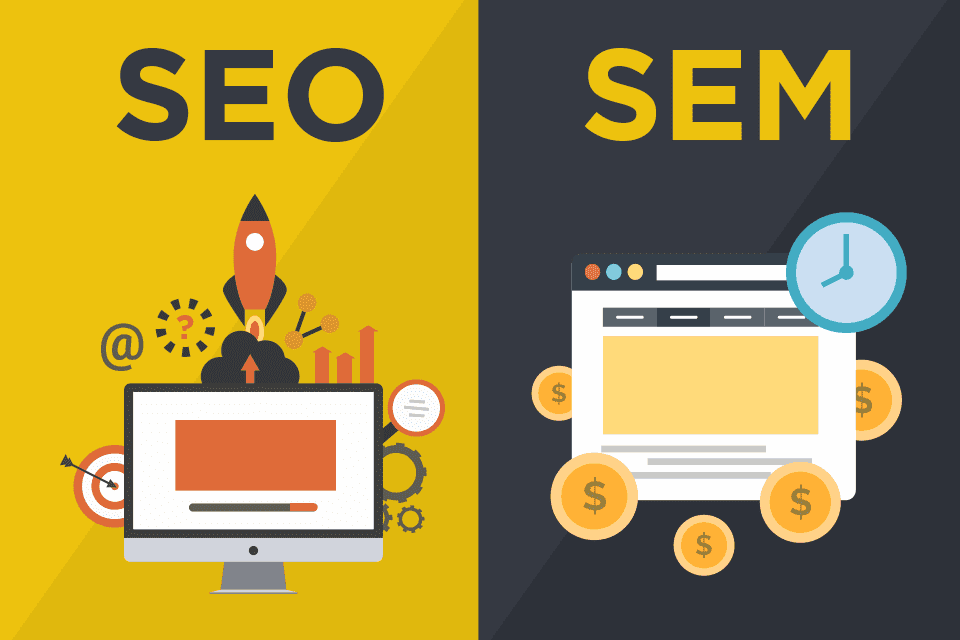
    SEO stands for Search Engine Optimization. SEO is an effort to optimize a website to get a top ranking in search results. If the position of your website is in the position of the best search results in the SERP it will allow others to find your website easily.

    Meanwhile, SEM stands for Search Engine Marketing. The definition of SEM is optimizing a website so that it appears in search engines by utilizing advertisements. In other words, the application of SEM requires tactics to properly advertise websites using various methods, such as Pay Per Click (PPC), and so on. It is clear that the implementation of this method requires a fee as well.

    Functionally, the two have quite a lot in common. However, in terms of how they work, they both have their own advantages and disadvantages. To be clear, let’s understand the difference between them.

    Understanding the Difference between SEO and SEM

    1.Target audience

    With SEM, you can choose the desired target audience, from age category, gender, region and others better than SEO. In addition, the target audience used in SEM is much more measurable and can be done at the beginning of setting up the ad.

    Whereas in the implementation of SEO, you can’t necessarily target the audience. You need to increase the content first on the website, then you can analyze whether the content is in accordance with the set targets. If not, then you need to do a lot more optimization.

    2.Rate

    When viewed from the process, both SEO and SEM do not immediately appear on the first page of search. However, when compared to SEO, the speed of results provided by SEM can be felt faster. SEM can also be turned off if it turns out that the intended target has not been reached, then reactivated after you have redefined the target audience.

    3. Time Period

    In contrast to SEM, SEO will have a long optimization impact. Meanwhile, SEM will only last for a specified period of time. In other words, the duration of the ad only lasts according to the amount of the fee you pay. While SEO will last for quite a long time in accordance with existing developments.

    4. Budget

    The difference between SEO and other SEM is in terms of the required budget. SEM in the form of paid advertising definitely requires a predetermined budget according to the time period you want. So in order to use it, you have to prepare a budget that’s not small. While SEO can be used at no cost. Simply put, SEO is free and SEM is paid.]

    5. Potential CTR (Click Through Rate)

    Lastly, the potential CTR of SEO is greater than SEM. Even though SEO and SEM results appear on the first page at the same time, people are less likely to click on paid ads than SEO optimization results.

    This is because people tend to avoid the “ads” sign that appear together at the top of searches. They will think the link that appears with the ad/ads sign is just a regular ad and doesn’t necessarily have the content they want.

    Understanding the difference between SEO and SEM will help you make better decisions in improving website performance. Then choose and decide according to your current needs. More here

  • Tips to Increase Search Engine Optimization

    Tips to Increase Search Engine Optimization

    Having a job in digital marketing, one must be familiar with Search Engine Optimization. Digital workers have always hunted digital marketing with this organic type to compete to make the website rank on the first page of Google.

    Search Engine Optimization means improving the website to increase its visibility when people search for products or services related to business in Google. The better visibility pages have in search results, and the more likely they will garner attention and attract prospective and existing customers to a business.

    This Search Engine Optimization capability is quite easy for visitors to get information about a product or service. Therefore, the content created in an article must be SEO-friendly to make it easier for Google to recommend to visitors. There are several ways to increase the website to be on the first page of Google in the ways below.

    Keyword Research

    Keyword research is the first thing to do to create SEO-friendly content. In analyzing these keywords, you can get information on what keywords are most often used. The results of this keyword research are useful for getting a list of competitors, keywords that bring traffic to competitors’ websites, competitor content strategies, and backlinks that competitors get. The purpose of this keyword research is that the content produced later can be better than competitors.

    On-page Optimization

    When you already know the keywords used to create content, it’s time to optimize on-page from SEO. On-page optimization is more focused on content and how to use the right techniques to make content SEO-friendly. To find out how the on-page optimization process is, don’t miss the step by step below.

    On-page content

    Content is a part of the website that has an important role. If the website is likened to a vehicle, this content is the fuel to run the website. Therefore, to create content, required conditions must be considered. This on-page content serves to create the best website pages by relying on E-A-T.

    Content writer SEO must be an expert who can write content that requires comprehensive, detailed, and easy-to-understand content. Also, a writer should have authority for the website has the authority to discuss a particular topic. If the writer expert and have authority, then writeable to trust and to be a trustworthy website.

    On-page technical

    After writing the content, it is also important to optimize the technical aspects of the content. Things to know that must be complete in this on-page technical are meta title, meta description, URL, internal linking, heading structure, and mobile-friendly.

    Some tips that are worth trying, namely, an attractive title with a maximum of 50-55 characters, a description used a maximum of 156 characters, a URL that must be clean according to the title, using the and structures, recommend other articles from the website relevant, and use mobile-friendly writing.

    Off-page Optimization

    Off-page SEO basically tells search engines like Google how visitors feel about your website, which can help you become an authoritative site by increasing visibility. This method also encourages people to mention your brand and link it to the material on your website. Help from outside the content is also needed for website optimization. Some tips that need to be done include:

    Trust Backlinks

    Backlinks play an important role in assessing the performance of a website. Website must consider the choice of this backlink, and although it has added value for those who include it, it is also quite risky if the links listed are from irrelevant links. It is better to use one backlink from an obvious source than many but irrelevant ones.

    Social Media

    After the content has been published, distribute the article with the help of social media to attract visitors to the website. Increasing the number of visitors can also increase traffic so that search engines can consider the website.

    Blog comment

    A good article can make the reader active. Therefore, the writing that is made must provoke the reader to comment if a lot of comments from visitors can make a better assessment.

    Measurement

    after all the steps have been done, don’t just stop there. It takes seo measurements to find out what our website visitors are like. There are several ways that can be done to measure SEO.

    Analytic

    First to know is Google Analytics. Google Analytics provides basic audience and behaviour metrics. It can segment user demographics, their devices to access your site, and whether they have visited your site before. It can also track website ad performance and overall traffic count.

    Behaviour

    It’s important to know user behaviour, use Crazy Egg to track. This trusted website visitor tracking resource provides intuitive “snapshots” of user behaviour. The Crazy Egg report includes a heatmap of website clicks, scroll times, and bounce rates combined with rich visitor information meant to offer a complete overview of each unique experience and how they interact with the content on your site.

    Visitor ID

    For this step, the best way to know visitor identity using Leadfeeder. Leadfeeder provides visitor identification and tracking software to assist marketing and sales departments identify and convert the best leads. Their account-level visitor identification technology ties every website visitor back to the company. The report, which visitor identity can integrate with many of the major CRM platforms, shows whether prospects are “warm” and to what extent.